
In November 2025, a 170-pound loggerhead turtle named Molly was released at Higgs Beach in Key West. The video went viral—100 million views across platforms, coverage from BBC to Brazilian media, 453 million people reached. No paid distribution. No influencer seeding. Just a story that mattered.
Three weeks earlier, Lilly Pulitzer had launched its Spring 2026 collection on a Casa Marina runway in the same city, with Chanel Iman, Mariel Hemingway and other influencers posting to their millions of followers.
And throughout the fall, 34 radio stations from Buffalo to Sacramento ran simultaneous contests driving 48,000 entries from people competing to visit the Florida Keys.
These weren’t three campaigns. They were three parts of a single ecosystem that generated $9.2 million in earned publicity value, reached millions of people, and created something more valuable than awareness: a coherent narrative about what the Florida Keys actually is.
This is what modern destination marketing looks like when it stops chasing individual activations and starts building coordinated ecosystems.
Campaign 1: The Luxury Anchor. Lilly Pulitzer’s Homecoming.
Lilly Pulitzer didn’t just return to Key West. The brand returned home. The designer first found inspiration on the island in the 1960s, and rather than treating this as a transactional partnership, Visit Florida Keys positioned the Spring 2026 collection launch as a cultural homecoming.
The orchestration was intentional. The Hemingway Home & Museum hosted the opening dinner. Historic Tours of America’s Conch Tour Train guided influencers through the island’s aesthetic heritage. Danger Charters positioned creators on the water wearing archival Lilly Pulitzer prints against Key West’s literal seascape. There was even a seaplane from Tropic Ocean Airways to pay homage to a historic photo of Lilly sprinting out of a seaplane carrying fabric. Casa Marina’s newly redesigned “Stay Like Lilly” suites embedded the brand narrative into the physical space—hand-painted walls, layered archival patterns, spatial storytelling that felt more like cultural curation than promotional takeover.
The Results:
Lilly Pulitzer’s Primary Account (905K followers):
6.4M followers reached
37,500 likes, 2,214 shares, 1,781 comments
98 partner mentions woven organically into content
Influencer Amplification (14+ creators, 5.8M combined followers):
The roster ranged from Chanel Iman (fashion model, 3.5M followers) and Mariel Hemingway (actress and Ernest Hemingway’s granddaughter) to emerging micro-creators with highly engaged audiences.
11,924 aggregate likes
1,635 shares, 875 comments
Consistent, organic mentions of Casa Marina Resort, Hemingway Home, Tropic Ocean Airways, Danger Charters
What made this work wasn’t the celebrity roster. It was the context. Every influencer was positioned within a narrative about heritage, creativity, and place. The destination wasn’t a backdrop for fashion—fashion became the lens through which the destination revealed itself.
The Lilly Pulitzer collaboration didn’t just create content. It created a reason to visit.

Campaign 2: The Mass Reach Orchestration. Promo Moxie’s Radio Ecosystem.
While Lilly Pulitzer anchored premium perception, a parallel strategy targeted something different: equitable, nationwide reach. Promo Moxie executed a three-part radio program across 34 markets that generated over 57.9 million impressions and proved that the old broadcast model (when reimagined) still moves the needle.
Part A: The National Collective Contest
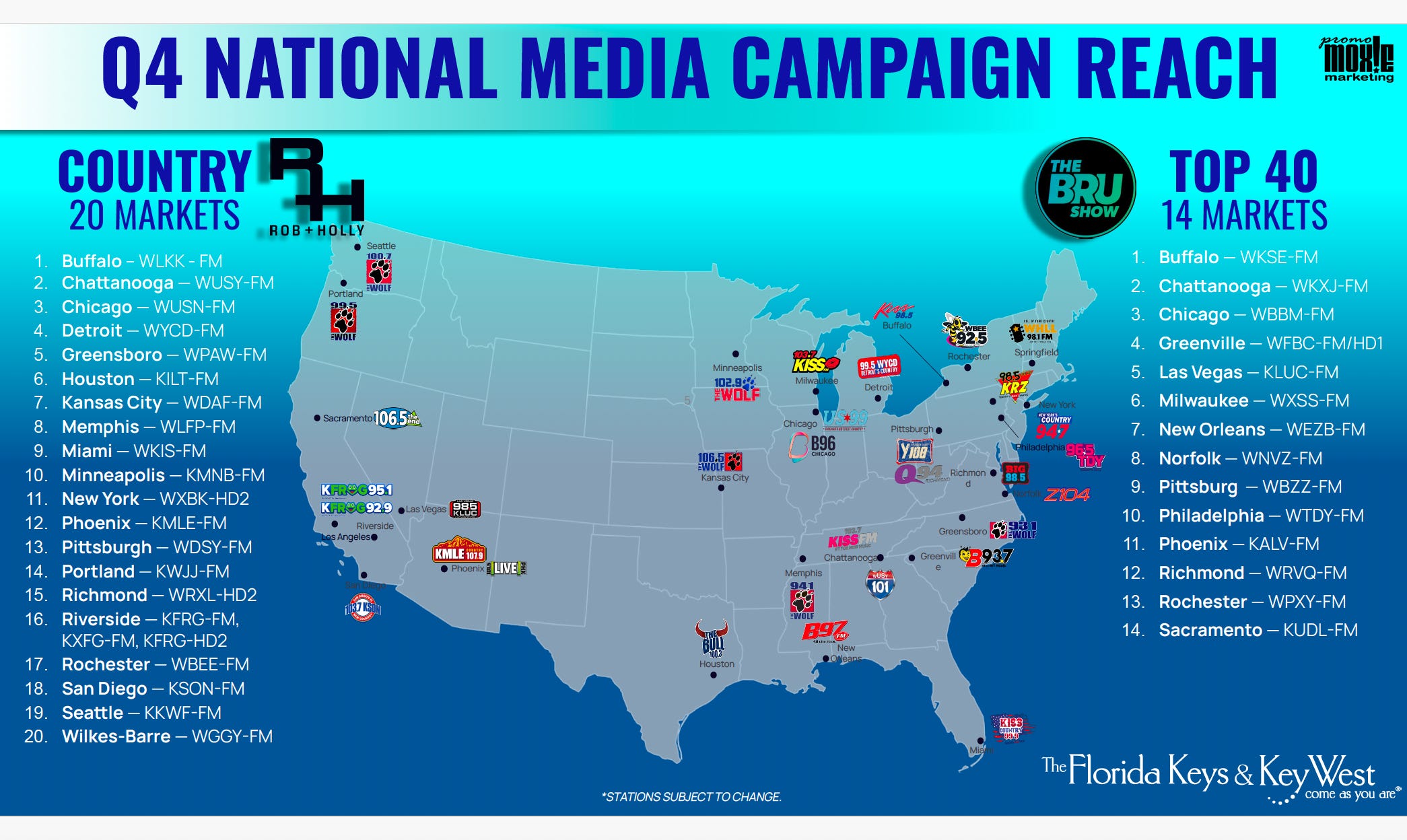
Across 34 radio stations in 20 Country and 14 Top 40/Hot AC markets (Buffalo to Sacramento, Miami to Milwaukee), two simultaneous contests ran for three weeks. Participants competed for Florida Keys experiences. The mechanics were simple. The reach was staggering.
Results:
8,082 promotional mentions (on-air + streaming)
21.6 million audio impressions
48,164 total contest entries
5,714 new leads directly attributed to the Keys
93+ social media posts amplifying the offer
The value: contests work because they require participation. Unlike display ads, a radio contest demands action—creating urgency, word-of-mouth momentum, and a database of people who self-identified as interested in the Florida Keys.
Part B: The Live Broadcast Tour
The contest created momentum. The live broadcast tour made it tangible. For five consecutive days, syndicated radio hosts from The Rob + Holly Show (Country) and The Bru Show (Top 40) broadcast live from five distinct Florida Keys locations: Key Largo, Islamorada, Marathon, The Lower Keys, and Key West.
Hosts conducted exclusive interviews with local partners, including resort managers, attraction operators, and hospitality leaders. They broadcast from oceanfront properties, water-based excursions, and cultural landmarks. Listeners heard authentic, real-time storytelling about what makes each district unique.
Broadcast partners included: Reefhouse Resort, Three Waters Resort, Hawks Cay Resort, Faro Blanco Resort, Oceans Edge, The Perry Hotel, Blue Flamingo Resort
Part C: Q4 Syndicated Show Entitlements
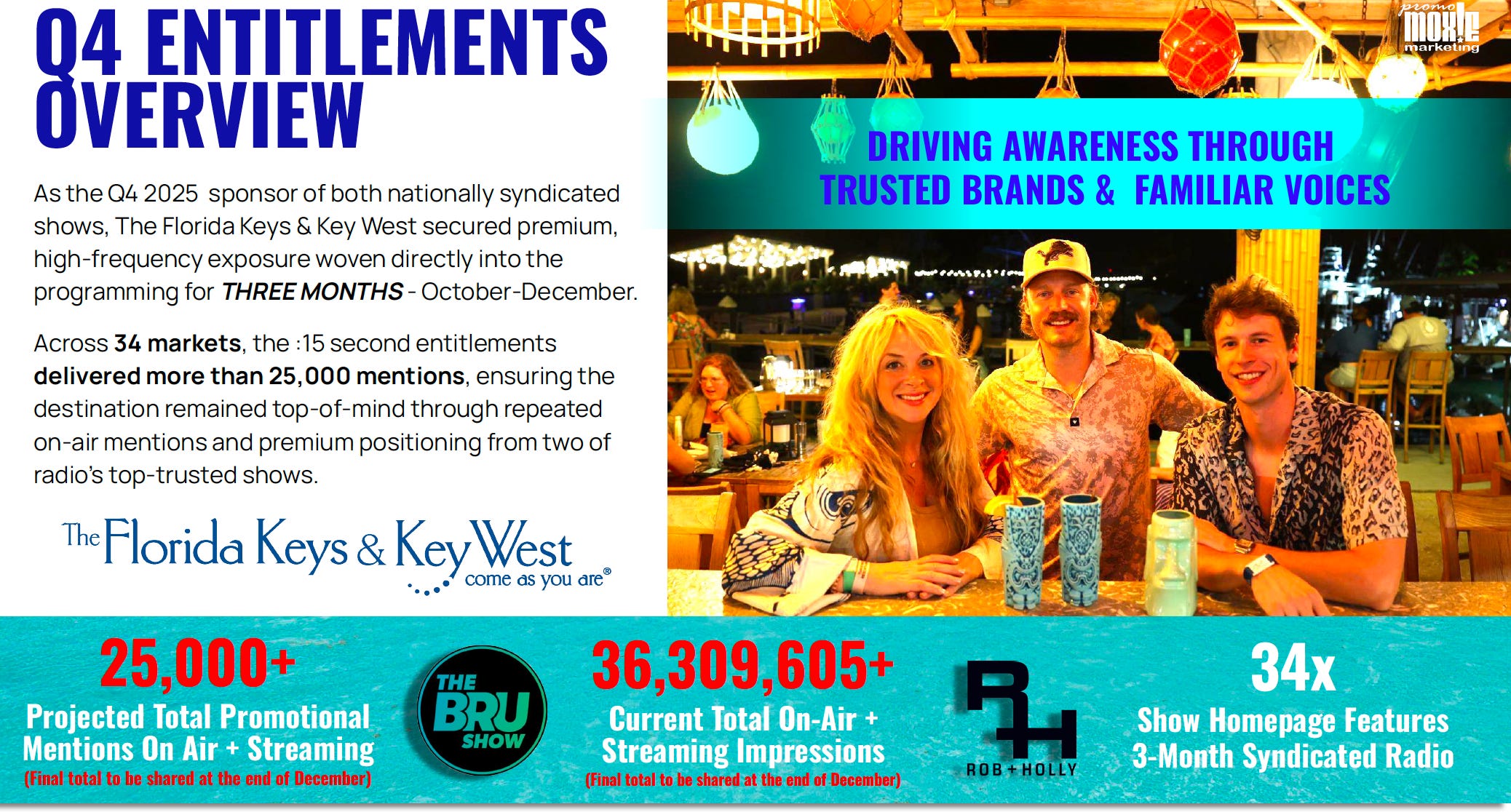
For the final quarter, Visit Florida Keys maintained premium, high-frequency exposure on two of America’s most-listened-to syndicated shows: The Rob + Holly Show (Country, 20 markets) and The Bru Show (Top 40/Hot AC, 14 markets).
These weren’t sponsorship mentions. They were woven destination-specific giveaways and thematic integration embedded into host conversations.
Results:
25,000+ projected mentions across October–December
36.3 million on-air + streaming impressions
34 show features with dedicated destination content
Total Promo Moxie Campaign Impact
33,082 total mentions (on-air + streaming)
57.9 million minimum impressions
5,714 new leads generated
Cost-per-lead efficiency that outperformed industry benchmarks for awareness-stage tourism marketing
What separated this from vanilla radio buys: the orchestration. Contest → Live Tour → Sustained Syndication. Each element fed the next. Listeners heard about the Keys on their commute, entered to win, then received updates about real hosts actually broadcasting from the destination. By the time the syndicated mentions began, the Keys had already entered cultural conversation.
Campaign 3: The Earned Media Narrative. Sea Turtle Conservation as Authentic Storytelling.
While luxury and broadcast reach built awareness, a third strategy built something harder to manufacture: emotional authenticity and earned media momentum.
The Florida Keys are home to the Turtle Hospital in Marathon, the world’s only veterinary hospital dedicated to treating sea turtles. We know that marine conservation isn’t a CSR sidebar—it is the destination’s beating heart.
Lenny Loggerhead: The Rescue That Captured Hearts
Lenny, a 322-pound loggerhead turtle, lost part of his front left flipper, had noticeable scarring on his head, and was treated with IV fluids, subcutaneous fluids, and broad-spectrum antibiotics. When the turtle recovered and returned to the ocean, media outlets didn’t just cover a rescue story—they covered a home story: a place where wildlife thrives because the community invests in its survival.
Results:
59 TV mentions (including NBC Nightly News)
20.1 million audience reach
$926,600 in measured publicity value
Coverage across Miami, Tampa, Sacramento, Oklahoma City, Las Vegas, Chicago
HSMAI Award (prestigious travel marketing recognition)
Molly: The Moment That Went Global
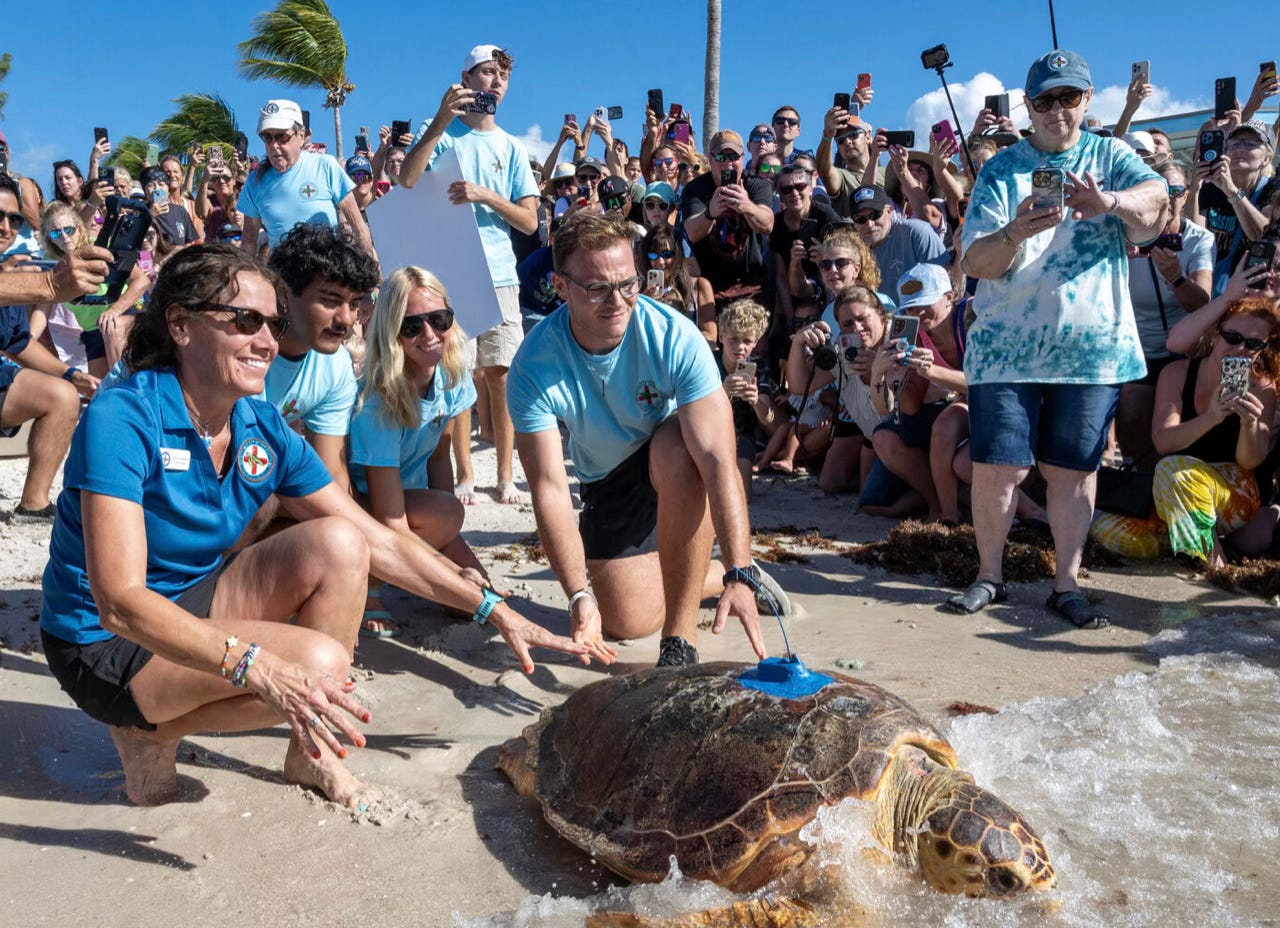
But Lenny was a prelude. In November 2025, a 170-pound loggerhead named Molly arrived after being caught in a crab trap, carrying a massive tumor. The three-hour surgery was documented. The recovery was filmed. The release, at Higgs Beach in Key West, was witnessed and amplified.
The results exceeded anything a paid campaign could achieve:
Results:
189 total mentions (TV, online, social, international)
453 million total audience reach
3.09M TV audience
420M online audience
30.2M social media reach
$8.3 million in measured publicity value
100+ million video views
Coverage across US, Canada, Brazil, UK, Singapore (not because of paid distribution, but because the story mattered)
Molly’s release video became a moment. Parents showed their children. Environmental groups shared it. News outlets from BBC to Brazilian media picked it up without prompting. The Florida Keys didn’t hire these outlets. The story earned them.
Tour de Turtles: Converting Momentum into Movement
Visit Florida Keys supported the Tour de Turtles program—a conservation initiative that tracks released turtles via satellite tags and follows their oceanic journeys. The VNR (video news release) generated:
Results:
225+ million reach
538 media mentions
Featured on Good Morning America, ABC World News Now
Positioned conservation as an ongoing narrative, not a one-off story
The Architecture: Why This Worked
Three campaigns. Three distinct strategies. One coherent destination narrative.
Most tourism organizations pick one lane: luxury influencers or mass reach or earned media. Visit Florida Keys recognized that modern audiences don’t live in single channels.
A high-net-worth traveler sees a Lilly Pulitzer post on Instagram. The same person hears about the Keys on their morning radio commute. Their teenage child discovers Molly the turtle and researches the destination independently. By the time they visit, they’ve encountered the Keys through different entry points, each reinforcing a different aspect of the destination’s identity.
Luxury (Lilly Pulitzer) = aspirational, heritage, culture, premium positioning
Mass Reach (Promo Moxie) = accessibility, nationwide awareness, democratic inclusion
Earned Media (Turtles) = authenticity, purpose, emotional resonance, global reach
The Measurable Outcomes
Total Reach: 1 billion impressions across all three campaigns
Direct Leads: 5,714+ attributed to radio (additional conversions from other channels not quantified)
Publicity Value: $9.2+ million in earned and sponsored media value
Awards: HSMAI recognition, industry credibility
Partnership Ecosystem: Extensive stakeholder and partner visibility
But the deeper win wasn’t the metrics. It was the coherence.
Each campaign reinforced the others. Lilly Pulitzer influencers mentioned the destination’s natural beauty and conservation ethos. Radio hosts visited partner properties during the broadcast tour, anchoring reach in real experience. Turtle content demonstrated the destination’s commitment to something beyond tourism: to stewardship.
A visitor arriving in Key West didn’t just see a resort. They arrived already embedded in a narrative about heritage, accessibility, authenticity, and purpose.
What This Means for Destination Marketing
The era of single-channel, single-influencer destination campaigns isn’t over—but it’s incomplete. Here’s what changed:
1. Orchestrated Ecosystems Over Individual Activations
Rather than executing a Lilly Pulitzer moment, a radio buy, and a conservation angle as separate line items, treat them as interlocking parts of a larger strategy. Each amplifies the others. Each speaks to different audience segments. Together, they create a destination narrative that’s impossible to ignore.
2. Luxury as Narrative Anchor, Not a Vanity Play
The Lilly Pulitzer activation worked because it was rooted in legitimate history and cultural significance. The brand had real ties to Key West. The partnership revealed the destination’s creative heritage, not just its resorts. Luxury partnerships that feel authentic build prestige; those that feel transactional build skepticism.
3. Mass Reach Through Partnership, Not Paid Impressions Alone
The Promo Moxie strategy generated 57.9 million impressions, but the real value was the partnership structure: contests that required participation, live tours that created genuine local visibility, and sustained syndication that kept the destination top-of-mind. This costs less than equivalent paid media and performs better because participation creates ownership.
4. Earned Media as Proof of Purpose
Sea turtle conservation isn’t just good PR—it’s the destination’s actual commitment. By amplifying real conservation work, Visit Florida Keys created a narrative that journalists wanted to cover, audiences wanted to share, and influencers wanted to champion. Purpose-driven storytelling scales farther than promotional messaging because it’s true.
5. Measure Holistically, Not in Silos
The Florida Keys tracked reach, impressions, leads, publicity value, and partnership mentions across all three campaigns. But the real measure was coherence: Did a potential visitor encounter the destination through multiple lenses? Did each touchpoint reinforce the others? Did the destination reveal itself as multifaceted—luxury and accessible, cultural and natural, aspirational and purposeful?
The Question Going Forward
Destination marketing is no longer about outshouting competitors. It’s about building ecosystems where multiple stakeholders—luxury brands, media partners, conservation organizations, hospitality operators, and local communities—all benefit from a shared narrative.
Three campaigns, zero contradiction, one narrative: a destination where heritage and nature, luxury and accessibility, aspiration and authenticity coexist.
The real test isn’t whether you can execute one great activation. It’s whether you can build a system where every activation makes the others more powerful.
In the end, people don’t visit destinations—they visit stories. And the strongest stories are the ones a destination tells together.
Read more:
The Florida Keys Grew While U.S. Travel Declined. Here’s How.
Show Me the ROI: How Four Pennies Power the Florida Keys Tourism Economy
The Uncertainty Advantage: Turning National Hesitation into Opportunity in The Florida Keys
Travel Interrupted: Why Federal Shutdowns Matter in the Florida Keys
AI Agents, Florida Fishing Guides and the Future of Destination Data
AI Agents & the Future of Hotel Marketing in The Florida Keys
Really sharp work here. The orchestration framework is what most DMOs miss, they run campaigns in paralel instead of building reinforcing loops. Molly the turtle generating $8.3M in earned media while Lilly Pulitzer anchors luxury positioning shows how authentic conservation narratives can outperform traditional influencer spend. The radio contest-to-live-tour sequencing is especially smart—each phase builds momemtum for the next rather than reseting to zero.
The Casa Marina x Lilly Pulitzer partnership was truly one for the books. Such a success story!